


B2B ecommerce has changed, and buyers are leading this shift by setting new expectations from B2B marketplace platforms. The classic sales-rep-first B2B play has moved to self-serviced B2B online marketplaces that let buyers lead interactions through Search → Compare → Order, just like their B2C experiences.
And that’s just the baseline.
Now, B2B buyers are increasingly looking for AI-powered B2B wholesale marketplaces that simplify supplier-distributor discovery, personalise bulk buying, and remove the noise from pricing and ordering. They’re not switching channels for deals anymore; they’re switching wholesale platforms for outcomes.
Table of Contents
- What Do Wholesale Buyers Expect From Their Multi Vendor B2B Marketplace
- 15 Must-Ask FAQs From B2B Marketplace Software Providers
- I. B2B Marketplace Setup
- II. Wholesale B2B Marketplace Cost And Customisation
- 4. What will be the total cost of different B2B features/plugins to build, run, and scale a B2B marketplace website?
- 5. Can we customise the frontend as well as the backend for unique requirements of our wholesale B2B marketplace?
- 6. What will be the cost of plugins for building mobile apps for my B2B marketplace?
- III. AI Capabilities Of B2B Marketplace Software
- 7. How is AI-powered B2B marketplace software better than legacy or custom built wholesale solutions?
- 8. What tools/features do you provide to rapidly add product taxonomy, descriptions, categories, and images for large catalogs on wholesale B2B marketplace?
- 9. Can we create AI chatbots/assistants for our unique B2B marketplace requirements?
- IV. Distributors And Integrations On B2B Marketplace Website
- V. Security, Scalability And Beyond 2026
- Conclusion
What Do Wholesale Buyers Expect From Their Multi Vendor B2B Marketplace
Today’s wholesale buyers want simple and smart catalogues, clear pricing, and buying journeys built for speed. If the platform can’t make wholesale buying feel effortless like modern trade, buyers are swift to change loyalties in a few clicks.
Here is the clear evidence backed by data:
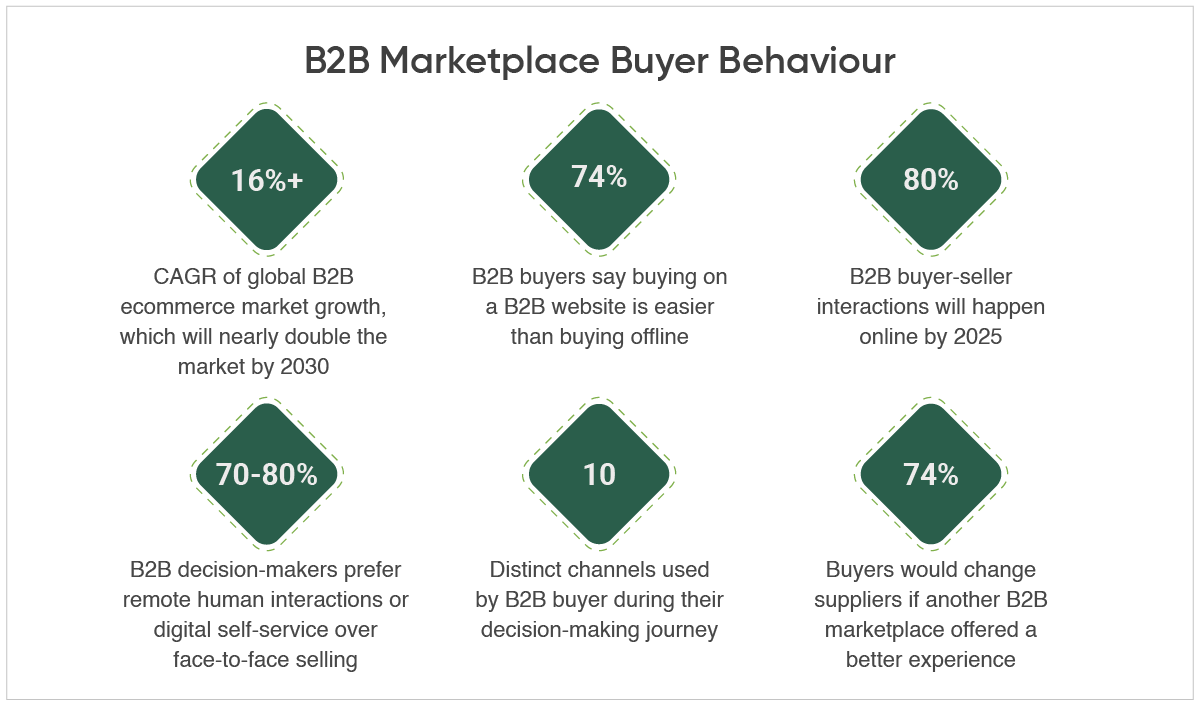
- 16%+ CAGR of global B2B ecommerce market growth, which will nearly double the market by 2030
- 74% of B2B buyers say buying on a B2B website is easier than buying offline
- 80% of B2B buyer-seller interactions will happen online by 2025
- 70-80% of B2B decision-makers prefer remote human interactions or digital self-service over face-to-face selling
- 10 distinct channels used by B2B buyer during their decision-making journey (up from just 5 in 2016)
- 74% of buyers would change suppliers if another B2B marketplace offered a better experience
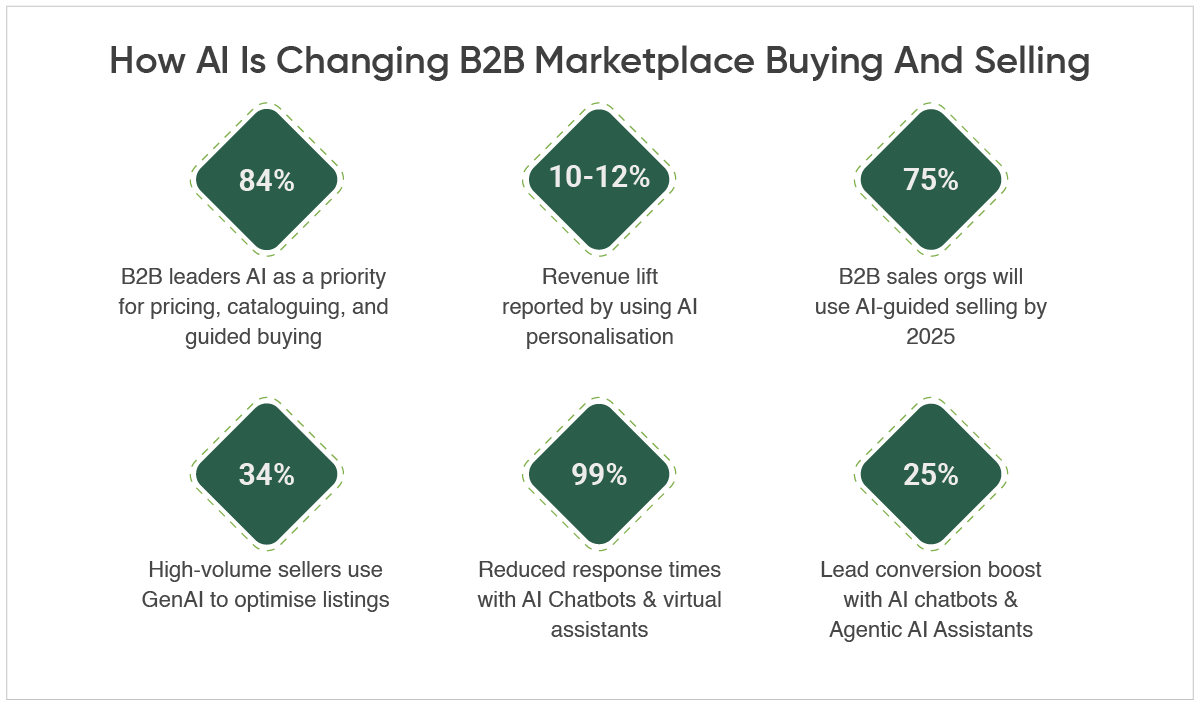
- 84% of ecommerce and B2B leaders now see AI as a priority for pricing, cataloguing, and guided buying journeys
- 10-12% revenue lift reported by businesses using AI personalisation
- 75% of B2B sales orgs will use AI-guided selling by 2025
- 34% of high-volume sellers already use GenAI to optimise listings
- 99% reduction in response times through AI Chatbots and virtual assistants
- 25% boost in lead conversion through AI chatbots and niche Agentic AI Assistants
Source: McKinsey B2B Pulse | Gartner Sales Predictions | Forrester B2B Predictions
Given these trends, choosing a B2B marketplace platform is no longer about who has the longest feature sheet. It’s about who removes friction for the buyer, seller, and distributor network, and who can prove it with outcomes, integrations, compliance, and intelligence.
Which is why, before you sign, migrate, or commit to a B2B marketplace software, you need to start by asking the right questions of your B2B marketplace platform provider. The sharper your questions, the safer your investment and the faster your returns.
As McKinsey puts it, digital B2B journeys now reward platforms that respond, connect, and simplify rather than just "enable clicks." And that means your platform decision should start with better questions, deeper validation, and zero assumptions.
15 Must-Ask FAQs From B2B Marketplace Software Providers
While there are many B2B marketplace platforms with a long feature list plugin ecosystem, the real test is how well the core system supports your buyers and distributors without slowing the business down.
Before you commit, it becomes imperative to compare key business sections and ask clear, detailed questions. The right answers will show whether the platform fits your B2B marketplace setup, and can grow with changing expectations of your business in due course of growth.
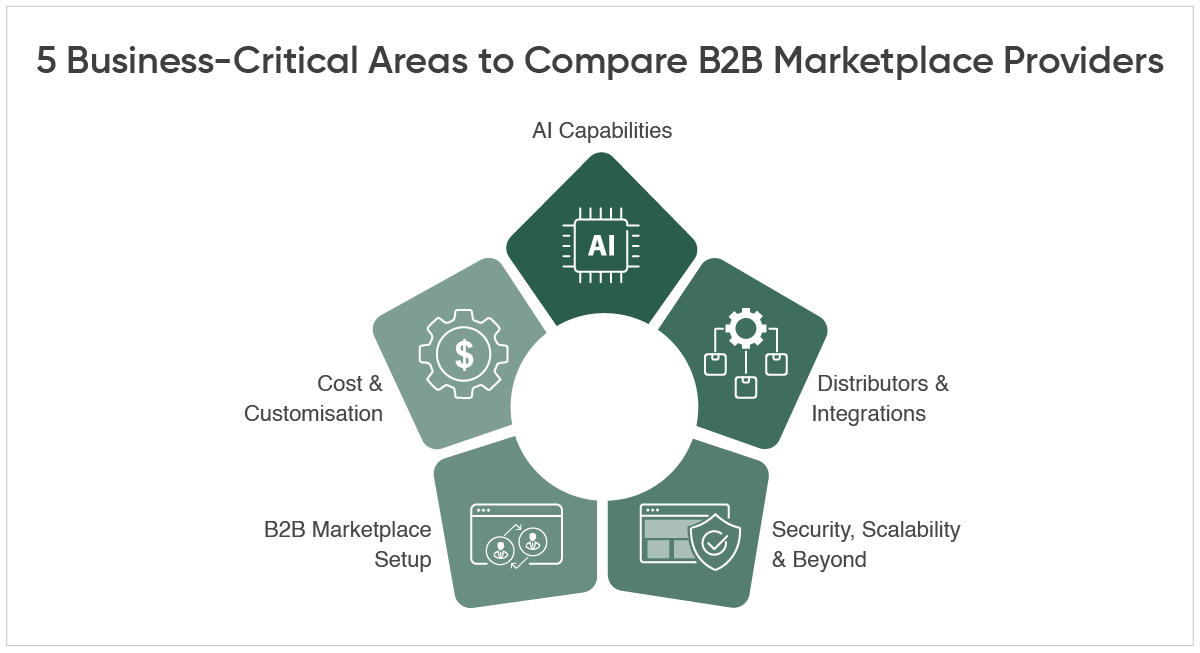
Here are the 15 questions and their detailed answers to help you find the best B2b marketplace software for your business:
I. B2B Marketplace Setup
1. What will be the GTM time to launch my distributor-based, multi vendor B2B marketplace?
GTM timelines for a dealer and distributor-based, multi vendor B2B marketplace depends on your use case, the B2B features you need, and how fast catalogues and customisations can be done. If the B2B platform relies on plugins for running the multivendor marketplace and B2B operations, timelines stretch because every plugin has to be tested, synced and aligned with the overall flow. Most enterprise wholesale builds factor 3 big blocks ; catalogue size, frontend/backend customisations and integration readinessand based on these the GTM time can vary between a few weeks to months.
With StoreHippo, built in B2B features and end-to-end wholesale marketplace solutions along with AI-powered cataloguing and image editor Magic Edit, it becomes much faster to build, customise and launch a B2B marketplace website even when you have large distributor networks with thousands of SKUs. Storehippo no-plugin built-in capabilities reduce build and testing loops. This means enterprise B2B wholesale marketplaces can typically go live in 4-8 weeks, depending on complexity and customisations, with cataloging and set up and deeper customisations can keep happening in parallel.
2. How can we scale our wholesale B2B marketplace across channels like mobile, website, PWA, WhatsApp etc?
To build omnichannel presence for a wholesale B2B marketplace, many companies end up creating fresh builds for every channel or relying on outside plugins and developers to connect each one. That can quickly pile up costs, time, and coordination overhead. It also entails repeated testing, data mismatch risks, and integration effort that slows teams down. For B2B buyer and distributor networks where repeat orders and catalog accuracy matter daily, this complexity becomes a real operational burden.
With StoreHippo’s built-in omnichannel support building a multichannel wholesale brand presence becomes easy. The same backend logic can be used to create multiple new channels like B2B marketplace website, PWA stores, Android and iOS apps using the zero-code mobile apps builder, and direct selling through a WhatsApp Business account. It also enables enterprises to build custom AI chat interfaces and tailored B2B marketplace software so your brand and distributors engage the clients on their favourite channels.
3. How can we build different distributor stores on our B2B marketplace?
On many B2B marketplace platforms, building separate distributor or dealer stores usually means adding marketplace plugins, then hiring developers to customise themes, pricing modules, or storefront logic for each seller. Since these plugins are created by different vendors, teams spend weeks aligning catalog formats, pricing rules, and overall buyer journey so the marketplace doesn’t break. The bigger the distributor network, the heavier the effort more plugins, more testing, more cost, more coordination.
With StoreHippo’s built-in support for vendor management solutions (DMS) and vendor storefronts, every distributor or dealer can get their own unique storefront on your B2B marketplace frontend. Each seller can manage their own catalogue, pricing rules, store design, and fulfill end to end orders (RFQ, negotiations, shipping etc) without external plugins. Admin always stays in control a dn have complete visibility, while distributors work freely in their own store view, keeping B2b ecommerce simpler and faster.
II. Wholesale B2B Marketplace Cost And Customisation
4. What will be the total cost of different B2B features/plugins to build, run, and scale a B2B marketplace website?
On different B2B marketplace platforms, costs vary a lot based on the features you pick and how many plugins you need to support wholesale, distributors or multi-seller operations. Some platforms offer marketplace basics but charge separately for add-ons like pricing modules, DMS, mobile apps, invoice tools etc. When these come from different plugin providers, the total cost increases further because you also pay for developer hours, testing, and integration work to make everything sync well. That’s why many enterprises evaluate platforms not just on capabilities, but long-term expense and effort too.
StoreHippo offers end-to-end B2B and marketplace features as part of your subscription. You don’t need any paid plugins or extensions to manage, run, and scale your marketplace. You simply pay the subscription fee, onboard sellers and distributors, and continue growing on one connected system. This makes forecasting yearly costs easier and far more predictable for wholesale B2B teams. Also, if If your business outgrows an existing subscription you can easily move to the next plan.
5. Can we customise the frontend as well as the backend for unique requirements of our wholesale B2B marketplace?
On different B2B marketplace platforms, the effort to customise frontend and backend can look very different. Many platforms limit backend changes because marketplace plugins, themes, or pricing layers are tightly boxed, and deeper customisations become hard, slow, or sometimes not possible at all. Some allow frontend edits but restrict backend logic, which makes adapting wholesale or distributor workflows tricky for business teams.
With StoreHippo’s pure headless, microservices, API-based B2b whole platform, you get more creative control on both sides, how pages look, and how data and workflows behave behind them. You can tweak the marketplace inside out for unique distributor, pricing, and catalog needs without hitting invisible ceilings. However, customisations on some complex builds cost additionally, usually calculated on a pro-rata basis depending on team hours and scope.
6. What will be the cost of plugins for building mobile apps for my B2B marketplace?
On most B2B marketplace platforms, mobile apps are usually an added line item. That means paying for plugins or app modules, then paying developers again to connect them to catalogs, pricing, and distributor logic on the marketplace. Plugin costs can vary based on whether you need Android, iOS, PWA support, ordering apps, or distributor store data visibility. Many platforms charge per plugin, per channel, or per user tier, which makes total cost hard to predict. On top of that, app plugins often need separate testing and backend alignment, adding more cost and time before launch.
With StoreHippo mobile-first solutions you get built in , zero code mobile apps builder to create B2b wholesale apps for your marketplace. You can create both Android and iOs B2B apps without writing a single line of code and by using the same backend logic which powers your B2b marketplace website. This also eliminates the need for multiple upgrades and syncs as your marketplace B2b apps are auto synced with changes in catalogs, distributors, design themes, pricing etc. So with StoreHippo B2B marketplace software , you do not have to pay additionally for mobile apps.
III. AI Capabilities Of B2B Marketplace Software
7. How is AI-powered B2B marketplace software better than legacy or custom built wholesale solutions?
Legacy or custom built wholesale marketplaces often start with big ambition but quickly hit practical limits. Every new channel, catalog format, pricing logic, or supplier workflow needs fresh development, repeated QA, and constant maintenance. These systems rarely evolve at the speed buyers expect today, which leads to slower discovery, supplier mismatch, and higher operational overhead. When buyer, seller, and distributor expectations change, custom systems become expensive to update and stretch internal teams thin.
With StoreHippo’s AI core B2B operations become faster, automated and standardisied across different ecommerce layers. To begin with, AI powered image editor Magic Edit makes images studio grade and automatic catalog generation means your distributors can upload product images and get optimised catalogs and product descriptions. AI-driven product search and recommendations help match buyers with the right SKUs, improving conversion and bulk-order efficiency. Because everything runs on one backend, you don’t have to stitch separate modules for wholesale logic, AI search, or catalog enhancement. You get a unified, intelligent B2B marketplace platform that keeps discovery, ordering, and scale smooth.
8. What tools/features do you provide to rapidly add product taxonomy, descriptions, categories, and images for large catalogs on wholesale B2B marketplace?
On many B2B marketplace platforms, creating large wholesale catalogs usually means pulling together different taxonomy plugins, image tools, category mappers, and content teams just to prepare one final upload. Each tool adds its own cost, learning curve, and testing cycle, especially when thousands of SKUs move through distributor approvals. It becomes fast to start, but slow to finish.
With StoreHippo, the heavy lifting is handled by built-in AI-powered cataloging tools. Image editor Magic Edit helps improve product visuals so they look cleaner and more consistent across large catalogs on your multi vendor B2B marketplace. The AI cataloguing system can read product images and create structured listings with product descriptions and categories, cutting down manual tagging time. With automation and AI intelligence catalogs across your website become standardised and also minimise human errors.
9. Can we create AI chatbots/assistants for our unique B2B marketplace requirements?
On many B2B marketplace platforms there is no support to build AI chatbots or assitants. Some platforms offer generic chat widgets, but deeper B2B bot customisation is often limited or not possible without external dev teams.
StoreHippo has already built different use cases of AI assistant for retail ecommerce called Mystore Genie, agri commerce AI assistant Kisan, and MSME support AI called Mitra. Your team can discuss the requirements of your niche AI chatbot/assistant with StoreHippo and get quotes for tailored development. Since these bots involve marketplace-specific logic and design, they will incur additional costs, usually worked out on a pro-rata basis depending on scope and team hours.
IV. Distributors And Integrations On B2B Marketplace Website
10. How can B2B marketplace admins monitor distributor listings, orders, and overall performance?
On several B2B marketplace platforms, admins do get a basic level of marketplace visibility, but granular tracking and tighter control over distributor catalogs, listing accuracy, or detailed order activity often requires add-on modules or plugins for marketplace software for distributors. Because these add-on DMS are built separately, teams usually end up paying extra and spending additional time making sure all parts sync smoothly. When decisions need to move faster, these shared but unconnected layers can create delay, gaps, and a lot more spreadsheet reliance than planned.
With StoreHippo’s built in DMS and end to end vendor workflows, master catalog, approval flow, seller ledger and other features, admins have complete visibility of dealer activities and performance from one central dashboard. Dealer storefronts can also be accessed and managed centrally by admins making the complex B2B wholesale marketplace setup simple and easy to manage.
11. How do we integrate our existing software on our B2B marketplace along with software used by our distributors?
On many B2B marketplace platforms, integrating existing software (ERP, CRM, DMS, accounting tools) usually means adding separate connectors or plugins for each system. Distributors then bring their own tools, which may or may not be supported natively. This creates a patchwork where every sync, upgrade, or change needs extra developer time and testing to keep data flowing correctly between systems. Over time, it becomes harder to maintain a clean, real-time view of orders, stock, and payments across the network.
StoreHippo API-first, headless B2B marketplace platform enables seamless integrations with existing software used by enterprise wholesale brands and their distributors. This enables brands to create their tailored B2B marketplace software by adding or replacing software, service providers as and when required.
12. Can I build a B2B marketplace with dealer-based hyperlocal deliveries?
On most B2B marketplace platforms, dealer or distributor deliveries aren’t built into the core marketplace. So you either tie up with delivery providers yourself, or ask every dealer to connect their own delivery by paying upfront for plugins or local logistics add-ons. That means more contracts, more onboarding time, and upfront costs just to enable hyperlocal deliveries through dealers. It works, but it’s usually a slow, stitched-together setup.
On StoreHippo, dealer deliveries become much easier to run because you already get over 30 pre-integrated delivery partners, plus delivery boy solutions so distributors can manage their own fleets and delivery teams for local order fulfilment. Dealers also get their own storefronts while admins see deliveries and orders centrally. This makes the whole set up seimpler and easy as dealers do not need to go checking and paying upfront for hyperlocal deliveries. StoreHippo also offers solutions to auto route orders to nearest dealer store to further simplify hyperlocal B2B marketplace set up.
V. Security, Scalability And Beyond 2026
13. How does your B2B marketplace platform handle peak demand?
Many B2B marketplace platforms offer cloud scalability, however for quite a few of them, this translates into extra planning and costs. Some platforms charge additionally for server add-ons, reserve capacity in advance, or hire developer teams to make everything perform well when catalogs get large or orders spike. Even when scale is promised, the bill usually gets bigger later because you’re paying for plugins, server upgrades, or extra tech help to keep things running smoothly.
StoreHippo’s cloud infrastructure is inherently scalable and provides elastic scalability that grows as demand grows. Enterprises don’t need additional team or support to manually adjust, resize or maintain any servers. Storehippo auto-adjusts for order spikes, multi-seller activity, and large distributor catalog loads.
14. What security certifications, compliance controls, and data protections are provided for enterprise B2B marketplaces?
Most B2B ecommerce platforms today offer basic security, but with varying depth. While this works for small setups, it feels risky when you’re dealing with wholesale volumes, sensitive distributor data, and large buyer networks. Often, you get basic protection but little clarity on compliance or audit logs needed for complex enterprise wholesale setups.
With StoreHippo, security and compliance are built in. Infrastructure runs on trusted cloud platforms that meet global standards. StoreHippo is ISO, PCI‑DSS, SCO certified and offers free SSL from the first day. Strong data-encryption methods, role-based access control and audit log track backend changes, and all sensitive data (like passwords or payment info) is properly encrypted. That helps ensure your wholesale B2B marketplace software remains compliant, data-safe, and trusted by distributors, buyers, and partners.
15. How does your platform future-proof B2B wholesale marketplace expectations beyond 2026?
Most enterprise B2B marketplaces already cover the basics,catalogs, pricing, seller stores, and delivery workflows. But future-proofing really comes down to how flexible the core system is when business changes, buyer expectations evolve, or new channels emerge. The platforms that last are the ones that don’t lock you into rigid templates and can adapt without constant rebuilds.
StoreHippo gives you native support for diverse business models not just B2B wholesale marketplace set ups. You can pivot to B2C/D2C brand stores, create distributor powered multi-store networks, set up international B2B marketplaces with multilingual and multi currency support and even create disruptive business models. Since the platform is pure headless and API-based, brands can redesign experiences, test new channels, or roll out a new commerce model without changing backend systems or starting from scratch. StoreHippo’s 300+ native features, 150+ pre-integrations which include payments, logistics, marketing tools and more give brands the flexibility and agility to implement new modules and workflows quickly. The AI core automates, standardises and helps with smarter selling to grow the brand. StoreHippo future proof B2B companies and brands and giving them the freedom and right tools to experiment and unlock new markets and possibilities smoothly and quickly without tech roadblocks.
Conclusion
Choosing a B2B marketplace platform is no longer just about “going online.” It’s about whether your tech can keep up with changing buyer behaviour, distributor expectations, new channels, and AI-driven ways of working. The questions you ask now decide how much time, money, and effort you save later, on plugins, custom builds, and constant firefighting.
If you’re planning a distributor-powered multi vendor B2B marketplace, it helps to see how these pieces come together in real workflows, not just on a feature sheet.
Experience B2B marketplace solutions designed for new-age wholesale brands. Schedule a guided StoreHippo B2B marketplace platform demo right away.





Leave A Comment