


What if your marketplace could evolve as fast as your customers do?
In today’s ever-shifting digital landscape, ecommerce success isn’t just about launching a multi vendor marketplace, it’s about future-proofing it.
Shoppers expect seamless experiences, faster innovation, and personalised journeys across every touchpoint.
And as your business scales, so do the complexities.
Here’s the catch: Traditional ecommerce platforms weren’t built for this kind of agility.
This is where a composable ecommerce ecosystem enters the scene.
Unlike monolithic setups, composable commerce lets you choose and connect best-of-breed solutions tailored to your unique marketplace goals.
Whether it’s plugging in a new payment gateway, customising vendor workflows, or launching new storefronts, it’s all possible without overhauling your entire system.
But why does this matter for your enterprise marketplace?
Because flexibility, speed, and scalability aren’t just “nice to have” anymore, they’re non-negotiables.
Table of Contents
- Flexibility to Build What You Need, When You Need
- 10 Powerful Reasons to Build An Online Marketplace on a Composable Ecommerce Ecosystem
- 1. Faster Time-To-Market with Ready Integrations
- 2. Seamless Vendor Onboarding and Management
- 3. Future-Proof Your Marketplace
- 4. Personalised Buyer Journeys Across Channels
- 5. Scalability to Support Hypergrowth
- 6. Omnichannel Commerce Made Easy
- 7. Headless Commerce
- 8. AI-Powered Ecommerce Platform
- 9. Composable Checkout for Optimized Conversions
- 10. Cost-Efficient Innovation and Maintenance
- Conclusion
- FAQs
Flexibility to Build What You Need, When You Need
Composable commerce enables a plug-and-play model where brands can innovate quickly, respond to changing customer expectations, and scale without being locked into monolithic systems. As retailers race to stay relevant in a highly competitive market, this modular approach offers a clear path to increased agility, improved customer satisfaction, and future-proof growth. In short, composable isn’t just a trend, it’s becoming the backbone of next-gen ecommerce.
Let us have a look at a few growth trends of composable commerce:
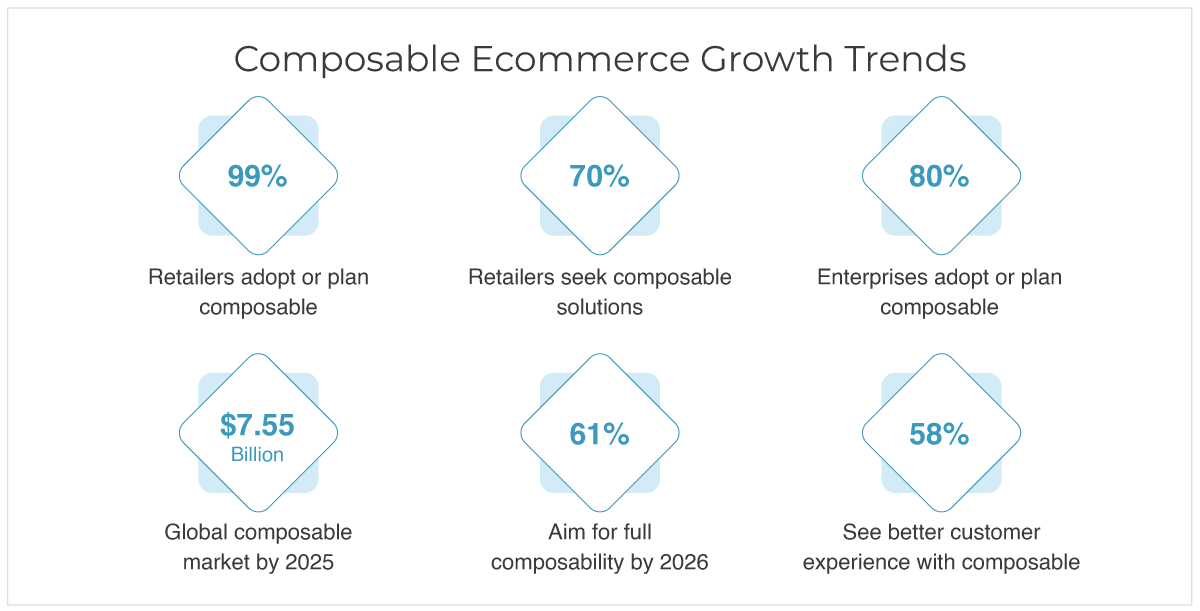
- 99% of retailers have either adopted or are planning to adopt a composable approach to commerce
- 70% of retail decision-makers now prefer and actively seek composable tooling
- 80% of enterprises have either adopted or are planning to adopt composable commerce
- $ 7.55 Billion is the estimated global composable applications market size in 2025
- 61% of organisations expect to achieve a fully composable architecture by 2026
- 58% of business owners adopting composable approach report improved customer satisfaction
Source: Global Insight Services, Gartner and Forrester
The era of one-size-fits-all is fading fast. In its place, composable ecommerce ecosystem is emerging as the preferred strategy for modern enterprises, empowering businesses to pick and choose the best-fit tools and services for every aspect of their operations.
10 Powerful Reasons to Build An Online Marketplace on a Composable Ecommerce Ecosystem
In this blog, we’ll explore 10 powerful reasons why building your marketplace on composable ecommerce gives you the competitive edge you need to thrive, adapt, and lead in the future of digital commerce.
Infographic: 10 Reasons to Opt For Composable Ecommerce Ecosystem for Your Marketplace
1. Faster Time-To-Market with Ready Integrations
Speed is vital in today’s ecommerce landscape, where every delay can mean lost sales. Composable platforms come pre-integrated with essential services like payments, shipping, taxes, and marketing tools. This plug-and-play approach eliminates the need for long development timelines and custom integrations, enabling brands to launch their marketplaces faster. Businesses can pivot quickly, roll out new features, or test channels without starting from scratch. With reduced go-to-market time, composable ecommerce ecosystem helps stay ahead of competitors and capture market share swiftly. This agility makes it easier than ever to build a marketplace.
StoreHippo helps enterprise brands like yours with seamless integrations of your own choice of software to build innovative solutions. StoreHippo’s headless APIs enable you to streamline your day-to-day business operations with its hassle-free and quick integration with third party softwares like CRM, ERP, accounting, and more. You can also integrate with multiple delivery partners, payment channels, chatbots, live chat etc. to offer a seamless shopping experience to customers on your enterprise marketplace.
2. Seamless Vendor Onboarding and Management
Onboarding vendors efficiently is key to scaling a marketplace. Composable platforms simplify this process with modular workflows that allow brands to customise onboarding experiences. An automated system helps vendors register, upload catalogues, manage orders, and align shipments seamlessly. By streamlining management tasks, brands reduce operational overhead and focus on growth. Whether it is about managing a few sellers or thousands globally, a composable ecommerce setup offers robust flexibility while building a multi vendor marketplace.
StoreHippo ecommerce solutions come with a comprehensive vendor management solution with end-to-end vendor onboarding and management features. With the easy-to-use, intuitive vendor dashboard from StoreHippo, even novice sellers can start their online journey seamlessly. While the admins have complete control over vendor activities, StoreHippo creates unique vendor dashboards to help them run and manage their business independently. Your vendors can upload products, track orders, and manage their inventory independently. StoreHippo also offers an adaptive payment feature that helps you divide a single payment made by a customer into multiple sellers as well as the admin.
3. Future-Proof Your Marketplace
Staying competitive requires constant evolution. Enterprise marketplace businesses need to adopt new technologies like AI, voice search, etc, replace outdated services, or scale functions without disrupting operations. This setup makes it possible to experiment with ecommerce trends and iterate faster. It’s how forward-thinking brands future-proof their marketplace using a composable ecommerce. An agile ecommerce platform is designed with modular architecture, making it easier to integrate new technologies, software and solution providers without overhauling the entire system.
StoreHippo ecommerce solutions are powered by MEAN (MongoDB, ExpressJS, AngularJS and NodeJS) stack. StoreHippo composable ecommerce ecosystem helps build cutting-edge solutions for marketplace websites of every scale and size, giving them the freedom to experiment, innovate, and scale with the powerful MACH architecture. With the unmatched flexibility and inherent scalability from StoreHippo, you can seamlessly future-proof your marketplace. StoreHippo comes with battle-tested solutions for B2B, B2C, D2C, B2B2C, quick commerce and other hybrid business models, giving your business the agility to evolve with tech trends.
4. Personalised Buyer Journeys Across Channels
Modern buyers expect tailored experiences, and a composable ecommerce ecosystem helps you offer hyper-personalisation. Enterprise brands can create personalised content, pricing, promotions, etc, based on user behaviour, location, device and much more. Brands can deliver consistent, relevant experiences across web, mobile, apps, and marketplaces with a composable ecosystem. Such personalised user experiences help foster stronger customer loyalty and drive conversions. The modular setup allows rapid experimentation with personalisation tools without having to alter the core systems. Businesses can swap out or upgrade components easily to keep up with buyer expectations.
Built on MACH architecture, StoreHippo enterprise marketplace solutions give you better creative control and agility to implement multi-level personalisations. With StoreHippo’s built-in features like drag-and-drop design tools, pricing overrides, discount engine, multilingual, multi-currency, etc. you can implement multi-level personalisations on your marketplace. You can offer personalised product prices based on customer segments and locations with the price override feature from StoreHippo. The powerful built-in discount engine helps you create personalised discounts and offers for your buyers. You can also send out personalised notifications to your buyers with the PUSH notification feature and recover abandoned carts seamlessly.
5. Scalability to Support Hypergrowth
Scaling your multi vendor marketplace shouldn’t mean replatforming every time you grow or expand. Building your marketplace on a composable architecture offers unparalleled scalability, whether you add new vendors, expand globally, onboard new services or add new products, the system grows with you. Its microservices-based structure lets enterprise businesses like yours scale individual components like catalog, checkout, or search independently. This flexibility reduces system strain and supports exponential growth. With no disruptions to existing operations, you can innovate faster while ensuring performance and stability. Such scalability makes a composable ecosystem a future-ready solution for any enterprise marketplace looking to thrive long-term.
Built on the most advanced technology stack, StoreHippo enterprise marketplace builder offers peak load tolerance with 99% uptime. StoreHippo comes with secure and inherently scalable cloud-native infrastructure, supporting the growth of your business so that you do not have to worry about the platform accommodating your business growth. The elastic scalability of the cloud-native infrastructure, along with the auto-provisioning of servers, ensures that your marketplace is built for peak load tolerance and can grow exponentially. The composable solutions from StoreHippo offer unmatched flexibility, inherent scalability, and superfast performance for your marketplace.
6. Omnichannel Commerce Made Easy
Consumers engage across platforms, from websites to social apps and offline stores. A composable ecommerce ecosystem helps unify these touchpoints from one backend. Brands can launch new storefronts for mobile or expand their reach on social commerce without duplicating infrastructure. This centralisation ensures consistent experiences while reducing operational complexity. Data from each channel can be seamlessly synchronised, providing insights for cross-channel marketing and inventory optimisation. With everything running on modular components, brands can test and deploy channels fast. This capability empowers businesses to build a marketplace that reaches customers wherever they are.
StoreHippo composable ecommerce solutions offer a ready-to-use omnichannel solution for the marketing needs of your enterprise brand. When you build an online marketplace with StoreHippo, you can quickly launch new customer touchpoints using the same backend logic and APIs. StoreHippo omnichannel solutions also help you strategise product-market mixes for faster growth and better audience engagement. StoreHippo also helps you leverage the most profitable channel and create data-driven strategies by offering insights from multiple channels of your marketplace.
7. Headless Commerce
Brand differentiation often starts with design. Headless commerce is the core to composable platforms that separates the frontend from the backend, offering complete creative control. Brands can develop immersive experiences, progressive web apps, or custom storefronts without being limited by platform templates. Composable ecommerce ecosystem, accelerates frontend development cycles as the same backend logic and APIS can be used to create new frontends, all the while ensuring consistent performance across devices.
The decoupled headless architecture from StoreHippo gives your marketing and development teams better creative control and agility to implement out-of-the-box solutions. With StoreHippo’s headless ecommerce solution and 300+ API endpoints, you can integrate the best software and services to build your tailored ecommerce environment. By separating the frontend from the backend, teams can quickly build, test, and launch unique experiences across multiple channels. This modular, API-first setup aligns perfectly with the principles of composable commerce, allowing brands to evolve their ecommerce ecosystem with the flexibility and speed needed for modern enterprise growth.
8. AI-Powered Ecommerce Platform
Want to build an online marketplace that can operate and sell intelligently without constant manual effort? In the AI era, your ecommerce ecosystem needs more than plug-and-play modules, it needs an AI core that can learn autonomously, respond instantly, and coordinate tasks to make every layer of your ecommerce operations faster, smarter and aligned for growth. This becomes critical when you run a large multi vendor marketplace where complexity spans catalogue accuracy, personalised recommendations, operational decisions, and seller support.
This is where StoreHippo AI-powered composable ecommerce platform takes a lead. With AI Commerce at their core, StoreHippo provides a host of built in AI capabilities to speed up cataloging, category mapping, enhancing product image with Magic Edit tool and helping customers find products faster with AI powered semantic search. It also enables enterprise marketplaces to build their tailored agentic AI shopping assistant or bots to enable conversations voice and text based multilingual shopping. You can explore AI for Ecommerce Mystore Genie, Agentic AI for Agri Commerce Mystore Kisan and Mitra AI for MSMEs tailored to helps sellers in every step of their journey.
9. Composable Checkout for Optimized Conversions
A rigid checkout can ruin conversions. Composable commerce lets businesses tailor checkout experiences based on customer location, payment preferences, cart contents, and browsing behaviour. Brands can optimise every stage from guest checkout to one-click payments, without touching unrelated systems with a composable ecosystem. This flexibility helps brands minimise cart abandonment and enhance customer satisfaction on their multi vendor marketplace. Customising checkout and offering a frictionless payment process for different audiences or regions offers a competitive edge to your brand.
Built on decoupled headless architecture, StoreHippo helps you build a flexible marketplace that can be tweaked inside out. You can implement customised shipping solutions and digital payments on your marketplace with StoreHippo. You can choose from 60+ pre-integrated domestic and international payment options from StoreHippo. You can offer a frictionless payment process to your customers by integrating multiple payment methods on your marketplace. StoreHippo composable ecommerce ecosystem also enables you to implement multiple payment gateways based on the location or device of the buyers and supports transactions in multiple currencies.
10. Cost-Efficient Innovation and Maintenance
Traditional monoliths often carry unused features, slow updates, and high maintenance costs. Composable platforms change this by offering only the services you need. Brands can add or remove modules based on current goals, cutting down on overhead. Maintenance also becomes simpler since updates apply to individual components, not the whole stack. For businesses aiming to build a marketplace with efficient spending and fast evolution, a composable ecommerce ecosystem delivers unmatched ROI.
The fully hosted and managed enterprise ecommerce platform, StoreHippo comes with inbuilt support for diverse business models, helping you innovate and scale efficiently. It also comes with battle-tested solutions to help you build your marketplace in record time. StoreHippo’s built-in support for different business models and hybrid solutions makes it easy to pivot to new business models or combine two or more models to create a hybrid business model.
Conclusion
Building a successful enterprise marketplace demands more than just a robust ecommerce platform, it requires a dynamic, future-ready ecosystem. With a composable ecommerce solution at the core, businesses gain the power to scale, personalise, and innovate faster than ever. Composable architecture lets you choose best-of-breed components and plug them in as your business evolves, without having to wait on monolithic upgrades.
StoreHippo’s composable ecommerce ecosystem goes beyond the basics to offer a tailored, modular, and scalable foundation for your marketplace. Designed to support diverse business models and evolving customer expectations, StoreHippo helps you build an online marketplace that’s not just functional but future-proof.
Are you ready to lead the next phase of ecommerce evolution with composable ecommerce ecosystem? Explore StoreHippo solutions, book your guided demo right away.
FAQs
1. What does a “composable ecommerce ecosystem” mean in the context of a multi vendor marketplace?
A composable ecommerce ecosystem is a modular setup where each part of your store like catalogue, search, checkout, payments, logistics, marketing etc work as an independent, customisable or swappable block. This enables enterprise multi vendor marketplace brands to update or customise anything quickly without rebuilding the whole system.
With StoreHippo, enterprises get a ready-to-use composable ecommerce ecosystem built for complex models, enabling them to build an online marketplace and run a scalable multi seller marketplace.
2. Why is a composable architecture better than a traditional monolithic platform for marketplace software?
Traditional monolithic platforms are rigid and slow to change. A composable architecture allows each part of your multi vendor marketplace to scale, upgrade, or integrate independently, giving faster innovation, better fault tolerance and lower long-term risk.
StoreHippo uses a modern microservices and API based, cloud native and headless composable ecommerce ecosystem that lets enterprise marketplace brands customise deeply, add new business models, and create tailored marketplaces, free from monolithic platform’s limitations.
3. How does a composable system enable faster time-to-market for an enterprise multi vendor marketplace?
A composable ecommerce ecosystem lets brands experiment, add, replace, or tweak features without disrupting the entire setup. This makes it easier for a multi vendor marketplace to test ideas quickly and scale across new categories, regions, or product lines.
With StoreHippo, enterprises can launch newmarketplace websites, create location based-sub stores, upload new catalogues quickly using built-in AI cataloguing and AI image enhancer Magic edit and tweak the frontend and backend with ease. This modular approach makes it easier to build an online marketplace or scale an existing enterprise marketplace in weeks, not months.
4. Is a composable ecommerce ecosystem more expensive than a traditional platform?
No, a composable ecommerce ecosystem is not necessarily more expensive. In fact, it often reduces long-term costs by avoiding plugin overload, constant rewrites, and the maintenance issues that traditional platforms struggle with. Over time, this makes your multi vendor marketplace far more cost-efficient.
With StoreHippo, 300+ built in features, end to end marketplace capabilities, pre-integrated payment and logistics solutions, built-in marketing tools and analytics you get pretty much everything to build and run an online marketplace. This translates into, fewer third-party tools, fewer hidden expenses, and far less technical overhead. This gives enterprise marketplace brands a future-ready way to build an online marketplace with better ROI, predictable costs, and the flexibility to scale without rebuilding from scratch.
5. Does choosing a composable architecture mean higher dependency on developers or specialised teams?
No, it doesn’t. A composable ecommerce ecosystem may sound technical, but it actually reduces your dependency on developers because you only work on the parts that need change, nothing else. Most everyday tasks like catalog updates, vendor onboarding, or storefront design changes can be handled with simple, low-code tools, not specialised teams.
StoreHippo is built with this balance in mind. It gives you drag-and-drop design, ready marketplace modules for everyday operations, and intuitive controls so you can run an build and run your enterprise marketplace smoothly, even without a large tech team.
6. Is migrating from a monolithic marketplace platform to a composable ecosystem risky or complex?
Not necessarily. Migration to a composable ecommerce ecosystem is usually smoother because you can move in phases, shifting catalog, checkout, search, or vendor workflows step-by-step instead of doing everything at once. This reduces downtime and lowers the risk compared to a full rebuild.
With StoreHippo, the process becomes even easier. You get full migration support and can import products, users, orders, themes, and settings through guided steps, CSVs, and built-in tools. This phased setup lets your multi vendor marketplace or enterprise marketplace go live on a modern, flexible ecommerce platform with minimal disruption and downtime. StoreHippo also comes with channel migration tools for Shopify, Magento, WooCommerce and Amazon enabling your brand to migrate from these platforms in just a few clicks.
7. How long does it typically take to migrate an existing multi vendor marketplace to StoreHippo’s composable ecommerce platform?
For any enterprise marketplace, migration timelines depend on catalogue size, existing workflows, data structure, and the level of customisation needed. Moving to a composable ecommerce ecosystem like StoreHippo is done in stages, typically starting with essentials like product data, users, and past orders; so the business keeps running while upgrades roll out gradually, keeping risk and disruption low.
With StoreHippo, marketplace migration follows a clearer and more structured path, making planning easier for decision-makers. Importing core data, products, users, and order history for your multi vendor marketplace is usually completed within a fortnight, setting the foundation for the rest of the build. Replicating the marketplace front-end and user journey typically takes 4-8 weeks, depending on complexity and customisations. This phased approach ensures a realistic and safer migration of enterprise marketplaces.
8. How does composable commerce help reduce operational complexity in a multi vendor marketplace?
In a composable ecommerce ecosystem, marketplace platforms use modular services for key functions like vendor onboarding, cataloguing, pricing, payments, logistics, and settlements. Because each function operates independently, it becomes easier to make focused updates to one or few segments without breaking the whole flow. This reduces manual effort, speeds up approvals, and simplifies how enterprises build an online marketplace and scale it.
StoreHippo supports this approach by offering native marketplace solutions and built-in modules for sellers, product catalog, pricing overrides, order routing, logistics, commissions, and payouts, so businesses running a multi vendor marketplace can manage daily operations without stitching multiple third-party plugins together. This lowers operational friction, improves stability, and reduces the risks decision-makers worry about when scaling a marketplace.








Leave a Reply